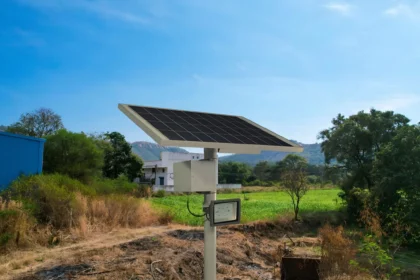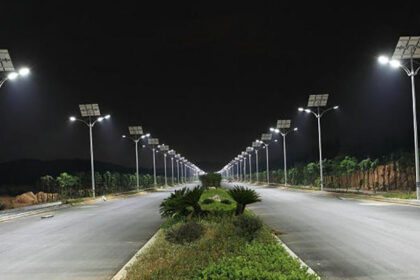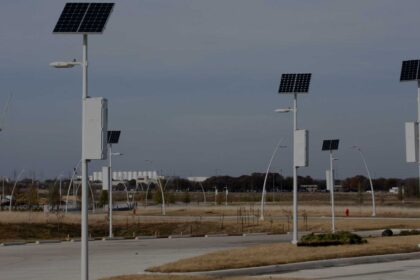

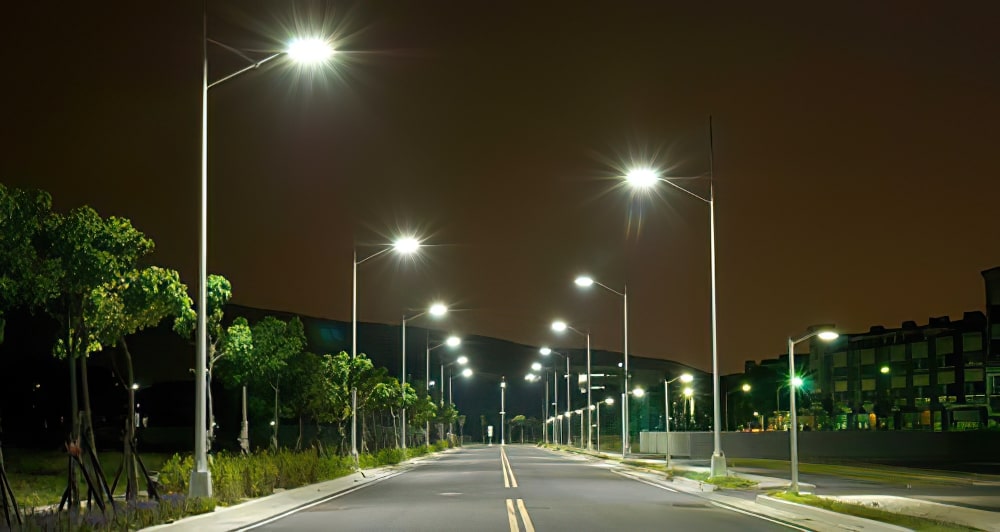
Street lighting plays a vital role in ensuring safety, mobility, and visibility in residential societies, campuses, rural roads, industrial complexes, and public streets. Traditionally, street lighting has relied on electric wiring and grid-based power, which can be expensive to install and maintain—especially across long distances. In recent years, solar-powered lighting has emerged as a practical alternative due to advancements in solar panels, lithium batteries, LED technology, and smart controllers. Today, some of the best solar street lights for roads and societies offer reliable illumination throughout the night with zero electricity bills and minimal maintenance, making them ideal for both urban and rural environments.
Solar street lights were once viewed as niche solutions, but they have now become essential infrastructure in many areas due to their energy savings and independence from the electrical grid. For housing societies, townships, gated communities, campuses, and rural development projects, solar street lighting solves a major challenge—providing night-time illumination without relying on unstable grid supply, trenching for wiring, or expensive power infrastructure. With India’s vast sunlight availability throughout the year, solar street lights have gained significant adoption in both public and private spaces.
Why Solar Street Lights Are Ideal for Roads & Societies
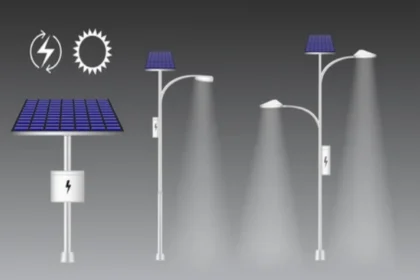
The core advantage of solar street lighting is autonomy. Each light contains its own solar panel, LiFePO4 or lithium-ion battery, MPPT controller, and high-efficiency LED lamp. This allows the unit to charge during the day and illuminate automatically at night without manual effort or grid connectivity. For roads and societies, this is extremely beneficial because installation becomes quick and cost-effective—no underground wiring, no power trenches, and no risk of electrical faults during rainy seasons.
Societies and residential layouts also prefer solar lighting because it improves safety and community living standards. Well-lit streets reduce accidents, discourage crime, and help residents navigate comfortably at night. In areas that experience power cuts, solar lights continue functioning without interruption, offering reliable night-time visibility. For municipalities and rural development boards, solar street lighting offers long-term savings because once installed, the operational cost is virtually zero.
Types of Solar Street Lights for Roads & Societies
Solar street lighting is available in multiple configurations depending on brightness requirements, height, and application. The two most common categories are integrated (all-in-one) and all-in-two (semi-integrated) street lights.
All-in-One Solar Street Lights:
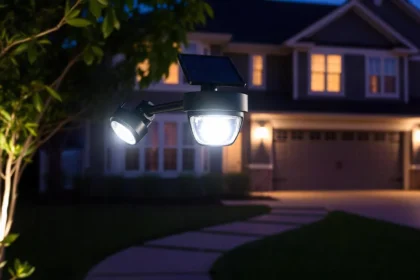
These lights have the solar panel, battery, LED lamp, and controller built into a single compact unit. They are easy to install and ideal for societies, campuses, small rural roads, and parks. Their compact design reduces installation time and maintenance requirements.
All-in-Two Solar Street Lights:
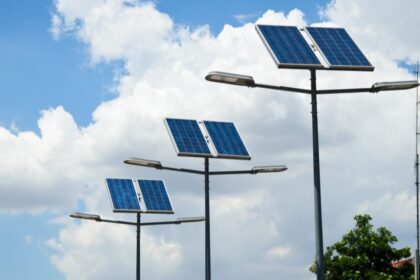
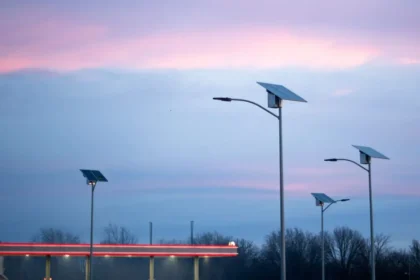
In this configuration, the battery and LED light are integrated together while the solar panel is separate. This design allows larger panels and higher wattage capacity, making them suitable for highways, longer roads, parking zones, and industrial layouts.
Both options offer smart dusk-to-dawn operation, motion-sensing capabilities, and energy-saving modes that extend battery life throughout the night.
Brightness & Wattage Considerations
Brightness is one of the most important factors when selecting the best solar street lights for roads and societies. Street lights must provide uniform illumination across pathways, roads, and open spaces. LED wattage and lumen output determine how effectively the light can cover an area. Societies usually require medium-range brightness suitable for residents walking, cycling, or driving slowly. Roads connecting neighborhoods may need stronger output, while industrial or highway-grade lights require significantly higher lumens.
Wattage ranges typically seen in solar street lighting include:
- 20W to 40W for internal society streets and parks
- 40W to 60W for connecting roads, campuses, and commercial layouts
- 60W to 120W+ for large roads, highways, parking areas, and industrial complexes
Modern LED chips produce high lumen output while consuming less power, which helps the battery last longer during the night. Motion sensor modes further optimize performance by increasing brightness only when movement is detected, conserving battery life during low-traffic hours.
Battery & Panel Efficiency
Battery technology has transformed solar street lighting over the last decade. Earlier models used lead-acid batteries, which were heavy, slow-charging, and low in cycle life. Today, LiFePO4 and lithium-ion batteries dominate due to higher efficiency, longer lifespan, and faster charging. These batteries maintain consistent light output even during cloudy or rainy days and offer long operational life—often between 3 to 7 years depending on usage and model quality.
Solar panel efficiency is equally important. Monocrystalline panels offer higher efficiency and better charging in low sunlight conditions compared to polycrystalline panels. For regions with cloudy monsoon seasons, larger panel sizes and MPPT (Maximum Power Point Tracking) controllers provide stable charging and longer run times.
Pole Height & Installation Factors
Solar street lights must be matched with appropriate pole heights to achieve optimal coverage. Internal society roads may only require poles between 4 to 6 meters, while public roads and industrial layouts often use 8 to 10 meter poles for broader coverage. Correct placement prevents dark spots, shadows, and uneven lighting. Since installation does not require underground wiring, poles can be set up within a few hours, making solar street lights practical for both new and retrofitted installations.
Weather Durability & Maintenance
Solar street lights operate outdoors year-round, so durability is a key factor. High-quality lights include weatherproof and dustproof housings rated IP65 or higher, protecting internal electronics from rain and environmental exposure. Aluminum alloy bodies and anti-corrosion coatings provide additional longevity—especially important in coastal regions where salt exposure accelerates corrosion.
Maintenance requirements are minimal. The primary ongoing task is cleaning solar panels periodically to remove dust, pollen, bird droppings, or pollution buildup, which improves energy absorption. Battery replacement may be required after several years, but the overall system remains functional for a long time with minimal intervention.
Final Verdict
The best solar street lights for roads and societies combine reliability, efficiency, weather resistance, and sustainability to deliver long-lasting illumination without grid dependency. With no wiring, zero monthly electricity costs, and automatic dusk-to-dawn operation, solar street lighting is one of the smartest investments for residential societies, campuses, industrial parks, and rural roads. As solar technology continues to advance in India and globally, more communities are shifting toward solar street lighting as a sustainable and cost-effective infrastructure solution. By choosing the right wattage, battery type, and installation design, roads and societies can achieve safer, brighter, and more energy-efficient outdoor environments.