
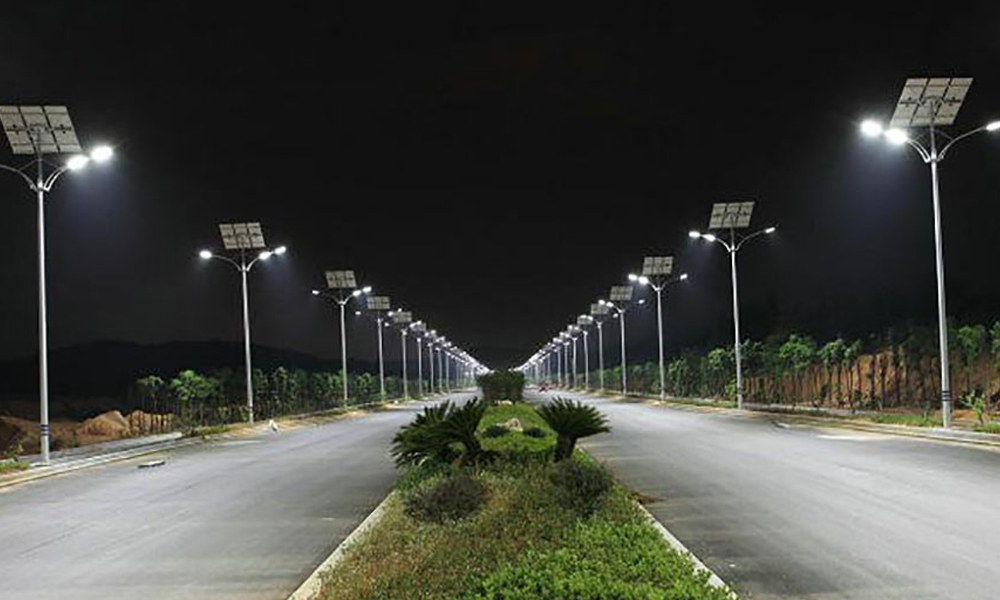
Solar lighting has become a popular choice for outdoor security due to its easy installation, zero electricity cost, and ability to function without wiring. Homes, residential societies, warehouses, farmhouses, and commercial buildings are increasingly adopting solar-powered security lighting to improve safety at night. However, a common question remains: Can solar lights work all night for security? The answer depends on several key factors, including battery capacity, solar panel efficiency, weather conditions, and lighting mode. When designed correctly, solar security lights can indeed operate throughout the night, but understanding how they achieve this is important for making the right purchase decisions.
Security lighting requires consistent illumination, especially in outdoor areas such as entrances, driveways, parking zones, side corridors, terraces, and perimeters. Solar lights are appealing because they work independently even during power outages, making them ideal for rural, semi-urban, and industrial environments. A reliable solar security light must have sufficient battery backup, efficient LED brightness, and weather-resistant components to survive outdoor conditions. Modern solar security lights have evolved significantly in recent years, aided by powerful lithium batteries, motion sensors, and smart power management systems.
How Solar Security Lights Operate Through the Night
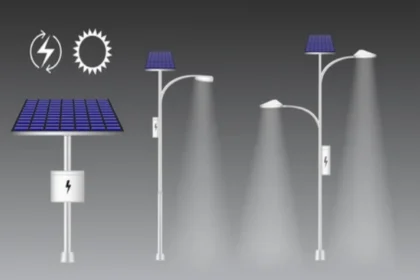
To determine whether solar lights can work all night for security, we need to understand how they store and use energy. During the day, the solar panel captures sunlight and converts it into electrical energy that charges the internal battery. After sunset, the light switches to battery power. If the battery is large enough and the LEDs are efficient, the light can operate for 8 to 12 hours or more. This duration is typically sufficient to cover the entire night in most regions.
The key component influencing nighttime performance is the battery. Older solar lights used Ni-MH or lead-acid batteries, which degraded quickly and provided limited backup. Modern solar lights use lithium-ion or LiFePO4 batteries, which offer higher energy density, faster charging, and longer lifespans. In regions with shorter winters and stronger sunlight—such as India—solar security lights can easily achieve full charging on most days, supporting continuous nighttime operation.
The Role of Motion Sensors in Battery Conservation
Many solar security lights are equipped with motion sensors to optimize battery usage. Instead of running at full brightness all night, they operate in low brightness or standby mode, then switch to high brightness when motion is detected. This greatly reduces power consumption and extends runtime during cloudy or rainy days. Even during winter or monsoon seasons, motion-sensing modes ensure that solar lights remain operational all night for security purposes.
Motion sensors are especially useful in low-traffic locations, such as backyards, alleyways, and farm entrances where continuous full brightness is unnecessary. By illuminating only when needed, the system ensures that the battery does not drain prematurely while still providing a security response when activated.
Impact of Weather & Seasonal Variations
The ability of solar lights to work all night for security can be influenced by seasonal changes. During summer and clear winter days, sunlight exposure is typically sufficient for full charging. During monsoon or long rainy spells, charging efficiency may decrease, especially in regions with dense cloud cover. In such cases, lights with larger solar panels and higher-capacity batteries perform better. MPPT charge controllers also improve charging efficiency in low-light conditions.
In cold climates, lithium batteries outperform other battery types due to better temperature tolerance. In hot climates, heat dissipation features protect LED chips and ensure consistent performance. Therefore, buyers in different regions should consider climate when selecting solar security lighting.
Battery & Panel Size Recommendations for Full-Night Operation
To ensure that solar lights can work all night for security, proper sizing of battery and solar panel is essential. Larger LED wattage requires larger battery capacity. For example, a 1500–3000 lumen security floodlight typically requires a sizable lithium battery and a large monocrystalline solar panel. Smaller wall-mounted motion lights may use smaller batteries but still achieve overnight operation when using low-power LED technology and motion detection.
Quality solar panels also play a crucial role. Monocrystalline panels offer higher efficiency and better performance during cloudy weather compared to polycrystalline options. Panels with proper orientation and tilt angle maximize energy harvest during the day, supporting consistent nighttime performance.
Real-World Performance & Limitations
In real-world conditions, well-designed solar security lights can operate all night with ease. Homes, industrial compounds, farmhouses, and warehouses across India already rely on solar flood lights and motion-sensor lamps for night-long illumination. The only limitations arise in poorly sized systems—specifically cheap models with small batteries, low-efficiency panels, and weak LEDs. These may not support full-night operation reliably, especially during monsoons.
Another limitation arises when buyers choose constant full-brightness operation instead of motion-based modes. Continuous full brightness consumes large amounts of power and may reduce runtime in cloudy seasons. However, when smart modes are used, most modern solar security lights perform consistently throughout the year.
Final Verdict
So, can solar lights work all night for security? Yes—provided the light uses efficient LEDs, a properly sized lithium battery, and a suitable solar panel. With the help of motion sensors and smart energy management, modern solar security lights are capable of running entire nights even during challenging seasons. For buyers looking to enhance outdoor safety without wiring or electricity bills, solar security lighting offers one of the most practical and cost-effective solutions. As battery chemistry and solar panel efficiency continue to advance, all-night solar security lighting will become even more reliable and accessible across residential, commercial, and rural environments.