



Street lighting is essential for public safety, mobility, and community development across cities, towns, campuses, industrial estates, and residential societies. Traditionally, street lighting has relied on grid-powered electric lights, which require cabling, transformers, switchboards, and continuous electricity supply. With advancements in renewable energy, solar-powered street lighting has emerged as a viable alternative, especially in regions with high sunlight availability. To decide between the two, buyers often evaluate installation cost, operational expenses, maintenance, reliability, and lifespan. This detailed solar vs electric street lights cost comparison explains how both systems differ and which offers better long-term value in 2026.
Solar street lights operate independently using solar panels and batteries that store energy during the day and power LEDs at night. They do not require wiring to the electrical grid, making them ideal for remote and underserved areas. Electric street lights, by contrast, rely on grid infrastructure and consume electricity continuously. While electric lights are capable and well-established, the growing emphasis on sustainability and cost efficiency has led governments and private developers to compare solar alternatives more seriously than ever before.
Installation Cost Comparison
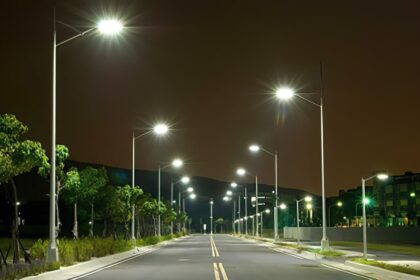
Installation is one of the biggest cost differentiators in the solar vs electric street lights debate. Electric street lighting requires extensive groundwork, including trenching for cables, underground conduits, feeder pillars, distribution boards, transformers, and skilled electrical labor. These infrastructure components can significantly increase the upfront cost, especially over long road lengths.
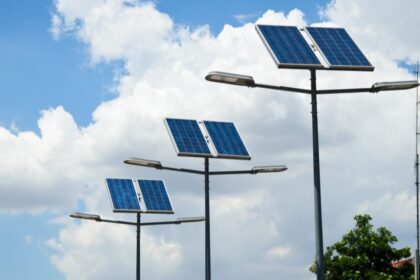
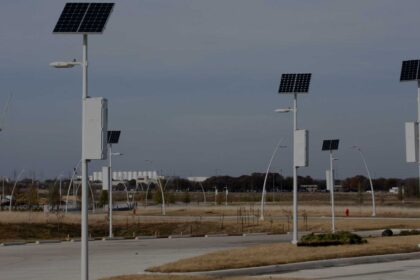
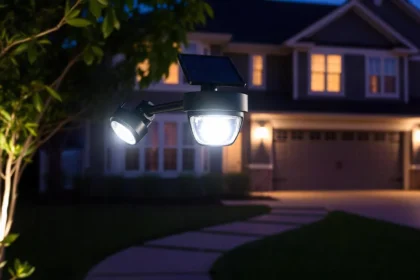
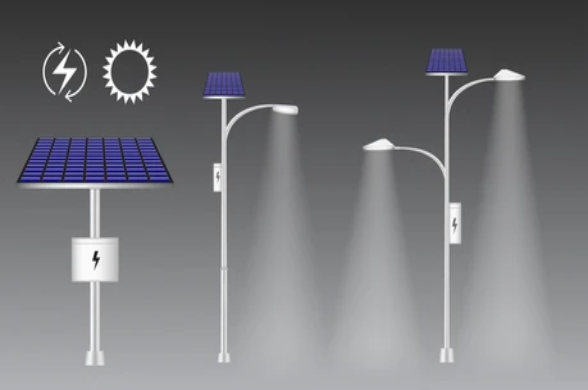
Solar street lights eliminate much of this complexity. Since each solar unit is self-contained—with its own panel, LED, controller, and battery—the need for underground wiring and grid connectivity disappears. Installation typically involves mounting the light on a pole and securing the panel. In many cases, installation can be completed within hours rather than days. While the per-unit cost of a solar street light may initially appear higher, the absence of trenching and electrical infrastructure often makes solar cheaper in large-scale or remote deployments.
Operational & Electricity Cost Comparison
Grid-powered electric street lights incur continuous electricity expenses, billed monthly by utilities. Depending on the wattage of the street light and number of operating hours, these costs add up significantly over time. For municipalities, housing societies, and private townships, electricity bills for street lighting can become one of the major recurring expenses.
Solar street lights have zero operational electricity cost because they run entirely on sunlight. Once installed, they do not draw from the grid and thus do not contribute to monthly bills. This is a major advantage over the life of the system. In areas with frequent power cuts, electric street lights may stop working during outages, while solar street lights keep functioning, making them more reliable for rural and semi-urban areas.
Maintenance & Repair Cost Comparison
Maintenance requirements differ between the two systems. Electric street lights require periodic inspections of cables, junction boxes, switches, and connections. Cable faults, transformer issues, and voltage fluctuations are common maintenance challenges. Repairing underground wiring and feeders is expensive and time-consuming, especially during rainy seasons when electrical faults are more common.
Solar street lights have fewer failure points. Maintenance mainly involves cleaning the solar panel to remove dust or bird droppings and replacing the battery after several years. Modern lithium-ion and LiFePO4 batteries have lifespans of 3 to 7 years depending on usage and climate. LED modules often last 50,000+ hours, and solar panels can function for 15–20 years with slow degradation. Overall, solar units tend to have lower long-term maintenance costs than wired electric systems.
Infrastructure Requirements
Electric street lighting is infrastructure-heavy. It demands access to the grid, transformers, feeder lines, electrical pole spacing, and safety systems. In rural and mountainous regions, extending grid infrastructure is costly and sometimes impractical. In cities, electrical trenching disrupts traffic and requires permits.
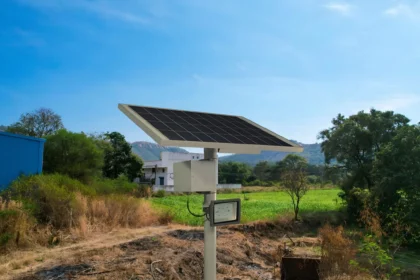
Solar street lights are infrastructure-light. They are ideal for locations without reliable grid access, such as rural villages, border roads, remote plantations, highways, campus perimeters, and industrial zones. Their self-contained nature reduces dependency on utility infrastructure and shortens deployment timelines.
Reliability & Performance Considerations
Electric street lights deliver consistent brightness and can operate reliably as long as the grid is stable. In regions with strong grid infrastructure, electric lights remain a dependable option. However, power outages or grid failures can leave streets unlit, posing safety hazards.
Solar street lights rely on sunlight to charge the battery. During monsoon seasons or prolonged cloudy periods, battery charge may reduce, affecting run-time. However, advancements in larger panels, MPPT controllers, and LiFePO4 batteries have improved performance in low-light conditions. In rural regions where power cuts are frequent, solar lighting is often more reliable than grid-powered lighting.
Cost Summary: Solar vs Electric Street Lights
A simplified cost summary across key categories looks like this:
- Installation Cost: Solar is often lower due to minimal infrastructure
- Operational Cost: Solar has zero electricity bills; electric has recurring bills
- Maintenance Cost: Solar has lower long-term maintenance; electric requires repairs and inspections
- Infrastructure Need: Electric requires grid infrastructure; solar is self-contained
- Long-Term Value: Solar offers stronger lifetime savings in most cases
Final Verdict
When comparing solar vs electric street lights in terms of cost, solar lighting often delivers superior long-term economic value. While electric lighting may appear cheaper in highly urbanized areas with strong grid networks, solar street lights eliminate electricity bills, reduce maintenance costs, and enable installation in remote or infrastructure-poor regions. For municipalities, universities, private societies, and industrial parks committed to sustainability, the cost savings and environmental benefits make solar street lighting an increasingly attractive solution. As India continues investing in renewable energy and smart infrastructure, the shift toward solar street lighting is expected to accelerate throughout 2026 and beyond.